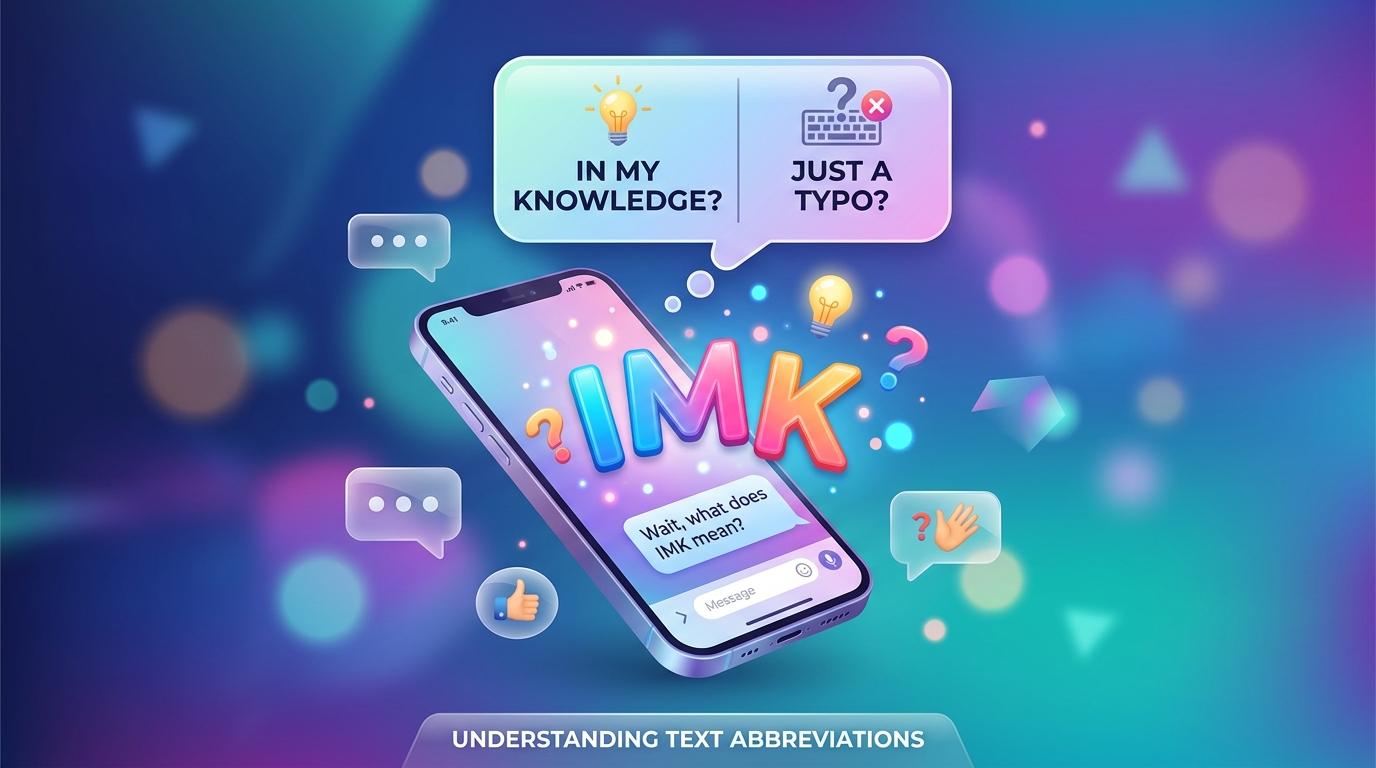
You are reading a message when the letters “IMK” suddenly appear. The sentence looks almost understandable, but the abbreviation makes you pause. IMK is commonly explained as “In My Knowledge,” meaning the sender is sharing information based on what they currently know.
However, it is not one of the most widely recognised texting abbreviations, so it may sometimes be confused with LMK or interpreted differently depending on the conversation.
What Does IMK Mean in Text?
In casual texting and online chat, IMK usually stands for “In My Knowledge.”
It is used in a similar way to phrases such as:
- As far as I know
- Based on what I know
- From my understanding
- To the best of my knowledge
For example:
“IMK, the meeting starts at 10 tomorrow.”
The sender believes the meeting begins at 10, but they are not claiming that the information is officially confirmed.
IMK therefore adds a small amount of uncertainty to a statement. It tells the reader:
“This is what I currently understand, but the information could change.”
Several slang references list “In My Knowledge” as the main texting meaning of IMK and describe it as a way of sharing information that the sender believes to be true.
IMK Meaning in Simple Words
The easiest way to understand IMK is to replace it with:
“As far as I know.”
Consider this message:
“IMK, Sarah is working from home today.”
The sender is not saying that they personally confirmed Sarah’s location.
They are saying:
“As far as I know, Sarah is working from home today.”
This difference matters because IMK makes the statement sound less absolute.
It may suggest that the sender is:
- Sharing the information available to them
- Leaving room for correction
- Avoiding an overconfident claim
- Admitting that details may have changed
- Trying to answer without pretending to know everything
IMK is mainly useful when someone believes something is correct but cannot guarantee it.
Is IMK a Common Texting Abbreviation?
IMK is a real abbreviation listed by several slang-reference websites, but it is less widely recognised than terms such as AFAIK, IMO, LOL, or LMK. Cyber Definitions even rates it as difficult to guess, which helps explain why readers often misunderstand it.
This means that using IMK may not always save time.
For example, if you write:
“IMK, the class has been cancelled.”
the other person may understand it immediately—or they may ask what IMK means.
When clarity is important, writing “as far as I know” is usually safer.
How Is IMK Used in a Sentence?
IMK normally appears at the beginning or end of a statement.
At the Beginning
“IMK, the shop closes at 8.”
This immediately shows that the information is based on the sender’s current knowledge.
At the End
“The shop closes at 8, IMK.”
This version sounds more casual, though it may be less natural to some readers.
In a Reply
Person A: “Has Daniel submitted the assignment?”
Person B: “IMK, yes—but you may want to confirm.”
The second person believes Daniel submitted it but is not completely certain.
When IMK begins a sentence, a comma can improve readability. In very casual chats, however, people often leave punctuation out.
IMK vs LMK: Do Not Confuse Them
IMK and LMK can look almost identical, especially when a lowercase “l” resembles an uppercase “I.”
However, they have very different meanings.
| Term | Full Form | Purpose | Example |
|---|---|---|---|
| IMK | In My Knowledge | Shares information the sender believes is correct | “IMK, the event starts at 7.” |
| LMK | Let Me Know | Asks someone to provide an update | “LMK when you arrive.” |
LMK is a widely recognised abbreviation for “Let Me Know.”
Compare these messages:
“IMK, the restaurant closes at 10.”
Meaning: Based on what I know, it closes at 10.
“LMK when the restaurant closes.”
Meaning: Tell me when you find out its closing time.
Mixing up these two abbreviations can completely change the message.
Where Is IMK Used?
IMK can appear wherever people communicate informally, although it is not equally common on every platform.
| Platform | Typical Use |
|---|---|
| Text messages | Sharing an update that may not be fully confirmed |
| Answering questions in personal or group chats | |
| Responding to questions in comments or direct messages | |
| Snapchat | Giving a quick answer based on current knowledge |
| TikTok | Discussing creators, videos, sounds, or trends |
| Reddit and forums | Sharing personal understanding without claiming authority |
| Gaming chats | Explaining updates, rules, items, or game features |
Text Message Example
“IMK, everyone is meeting at the café.”
The sender believes that is the current plan.
WhatsApp Example
“IMK, tomorrow’s class has been cancelled.”
This may be an update from a classmate, but it should still be confirmed through an official source.
Social Media Example
“IMK, that feature is only available for public accounts.”
The user is sharing their understanding of how the platform works.
Gaming Example
“IMK, you unlock that character after level 20.”
The player believes this is correct but may not have checked the latest game information.
Why Do People Use IMK?
People mainly use IMK to communicate uncertainty without writing a long explanation.
It Prevents Overconfidence
Instead of saying:
“The office is definitely closed.”
someone may write:
“IMK, the office is closed.”
The second version leaves room for the possibility that the information is incomplete or outdated.
It Allows Correction
IMK can quietly communicate:
“This is what I know, but you may have newer information.”
That can make conversations feel less argumentative.
It Softens a Correction
Compare:
“You’re wrong. The event is on Friday.”
with:
“IMK, the event is on Friday.”
The second version sounds less confrontational.
It Keeps Casual Replies Short
Instead of typing:
“According to the information I currently have…”
someone can write:
“IMK…”
However, because IMK is not universally understood, the shorter message is not always the clearer one.
Real-Life IMK Examples
School or University
“IMK, the assignment is due on Monday.”
Meaning: The sender believes Monday is the deadline but has not completely verified it.
Workplace Chat
“IMK, the manager is joining the meeting online.”
Meaning: The sender understands that the manager will attend remotely.
Travel Plans
“IMK, the last train leaves at 11.”
Meaning: The person believes 11 is the final departure time, but the official timetable should still be checked.
Social Media
“IMK, you need a public account to use that feature.”
Meaning: The sender is sharing what they currently understand about the platform.
Friendship
“IMK, Aisha isn’t upset with you.”
Meaning: The sender believes Aisha is not upset, although they cannot know her feelings with certainty.
Online Shopping
“IMK, they accept returns within 30 days.”
Meaning: The person remembers the policy but is not completely sure.
Gaming
“IMK, that item was removed in the latest update.”
Meaning: The player believes the item is no longer available.
IMK vs Similar Abbreviations
IMK is easily confused with other abbreviations that introduce opinions, memories, or uncertain information.
| Term | Full Form | Main Purpose |
|---|---|---|
| IMK | In My Knowledge | Shares information based on current knowledge |
| AFAIK | As Far As I Know | Shares information with limited certainty |
| IMO | In My Opinion | Introduces a personal opinion |
| IMHO | In My Humble/Honest Opinion | Expresses an opinion more softly |
| IIRC | If I Recall Correctly | Shares information based on memory |
| TBH | To Be Honest | Introduces an honest reaction or statement |
| LMK | Let Me Know | Asks someone to provide an update |
IMK vs AFAIK
IMK and AFAIK communicate almost the same idea.
“IMK, the event starts at 7.”
“AFAIK, the event starts at 7.”
Both sentences show that the sender believes the information is correct but is not making an absolute claim.
AFAIK is generally clearer because more people recognise it.
IMK vs IMO
IMK introduces information.
IMO introduces an opinion.
Compare:
“IMK, the restaurant closes at 10.”
This is a factual statement based on the sender’s knowledge.
“IMO, the restaurant is overpriced.”
This is a personal judgement.
IMK vs IIRC
Use IMK when referring to what you currently know.
Use IIRC when trying to remember something.
“IMK, he works in marketing.”
“IIRC, he started working there last year.”
The first message focuses on knowledge. The second depends on memory.
Is IMK a Typo?
Sometimes it may be.
Because uppercase “I” and lowercase “l” can look similar, someone who appears to have written IMK may actually have intended to write LMK.
For example:
“IMK when you arrive.”
“In My Knowledge when you arrive” does not make sense.
The intended message is probably:
“LMK when you arrive.”
Meaning:
“Let me know when you arrive.”
When IMK does not fit naturally into the sentence, check whether it may be an LMK typo before assuming another meaning.
Does IMK Have Other Meanings?
Abbreviations can carry different meanings in technical, organisational, professional, or private contexts.
Some websites list alternative interpretations of IMK, but many of these meanings are uncommon and may not be recognised by most readers. Even sources that identify “In My Knowledge” as the main meaning emphasise that context is necessary.
In an ordinary text conversation, begin with these possibilities:
- In My Knowledge
- A typo for LMK
- A private or context-specific abbreviation
Read the complete sentence before deciding.
When Should You Use IMK?
IMK may be suitable when:
- Answering a casual question
- Sharing information that is not fully confirmed
- Explaining what you currently understand
- Correcting someone politely
- Leaving room for updated information
- Participating in an informal online discussion
Example:
“IMK, you need to update the app before that option appears.”
This shows that you are trying to help without pretending to be an official source.
When Should You Avoid IMK?
Avoid IMK in formal or high-stakes communication.
Formal Emails
Instead of:
“IMK, the payment was processed.”
Write:
“According to our current records, the payment was processed.”
Academic Writing
Academic work requires evidence and clear attribution. IMK sounds informal and unsupported.
Important Instructions
Do not rely on IMK when discussing:
- Medical guidance
- Legal requirements
- Financial decisions
- Safety instructions
- Official deadlines
- Travel schedules
- Workplace policies
Verify important information through an official or qualified source.
When You Are Certain
When information is officially confirmed, IMK adds unnecessary doubt.
Instead of:
“IMK, your interview is confirmed for Tuesday.”
Write:
“Your interview is confirmed for Tuesday.”
When the Reader May Not Know the Term
Because IMK is not universally recognised, writing “as far as I know” may be clearer.
Common Misunderstandings About IMK
IMK Means “I’m Okay”
IMK does not normally mean “I’m okay.”
That phrase is usually written as:
- I’m OK
- I’m good
- IM OK
IMK may occasionally appear because of a typing error, but “I’m okay” is not its standard slang meaning.
IMK Means “I Might Know”
Some readers may guess that IMK stands for “I Might Know.”
However, “In My Knowledge” is the main meaning listed by established slang-reference pages.
IMK Expresses an Opinion
IMK is not the same as IMO.
IMK introduces information based on the sender’s knowledge. IMO introduces a personal view.
IMK Confirms a Fact
Adding IMK does not prove that a statement is correct.
It only tells you that the sender believes it is correct based on the information they have.
Everyone Understands IMK
IMK is less familiar than many popular texting abbreviations. When clarity matters, spelling out the phrase is better than assuming the reader knows it.
Is IMK Rude or Flirty?
IMK is not normally rude, offensive, romantic, or flirty by itself.
It can actually soften a statement because it prevents the sender from sounding completely certain.
Compare:
“That information is wrong.”
with:
“IMK, that information has been updated.”
The second sentence sounds less aggressive.
Any rude, sarcastic, or romantic tone comes from the surrounding message—not from IMK itself.
Frequently Asked Questions
What does IMK mean in a text message?
IMK is commonly understood as “In My Knowledge.” It introduces information based on what the sender currently knows, similar to “as far as I know.”
Is IMK the same as LMK?
No. IMK means “In My Knowledge,” while LMK means “Let Me Know.” IMK shares information; LMK asks someone to provide information.
What does IMK mean on Snapchat?
On Snapchat, IMK normally means “In My Knowledge.” However, because the abbreviation is not widely recognised, check whether the sender may have meant LMK.
Is IMK the same as AFAIK?
The meanings are very similar. Both introduce information that the sender believes is correct but may not have fully confirmed. AFAIK is generally more recognisable.
Can IMK be a typo?
Yes. IMK may sometimes be a typo for LMK, especially when the sentence is asking someone to provide an update.
Is IMK flirty?
No. IMK has no romantic meaning by itself. Any flirtatious tone comes from the rest of the message.
Final Thoughts
IMK is commonly listed as “In My Knowledge.” It is used when someone wants to share information without claiming complete certainty.
However, IMK is less recognisable than AFAIK or LMK. Before interpreting it, read the complete sentence and check whether it makes sense as “In My Knowledge” or whether the sender may have typed LMK by mistake.
In casual conversations, IMK can be a quick way to show uncertainty. In formal or important communication, complete and precise wording is the better choice.
Related Articles:
https://meanzia.com/what-does-wtm-mean-in-text/
https://meanzia.com/gtg-full-form-in-chat/
https://meanzia.com/bb-meaning-in-text/

Jasmine is a dedicated content writer at Meanzia, where she creates informative and engaging content about internet slang, texting abbreviations, social media trends, dream meanings, and online communication. She is passionate about making complex topics easy to understand through clear explanations, practical examples, and well-researched articles. At Meanzia, Jasmine focuses on delivering accurate, trustworthy, and reader-friendly content that helps people stay updated with the latest digital language and online culture.